3D in the chat
No link to open: Kiln’s 3D view appears inside Copilot’s chat in VS Code, right under the step that made the part.
Kiln in GitHub Copilot
Kiln gives Copilot what it needs to design a part, check it will print, and run it on your own printer. The part opens in 3D right in VS Code’s chat.
Copilot designed a planetary gear set with Kiln, and Kiln’s 3D view opened inside VS Code’s chat to show it, then checked it for a Bambu Lab A1.
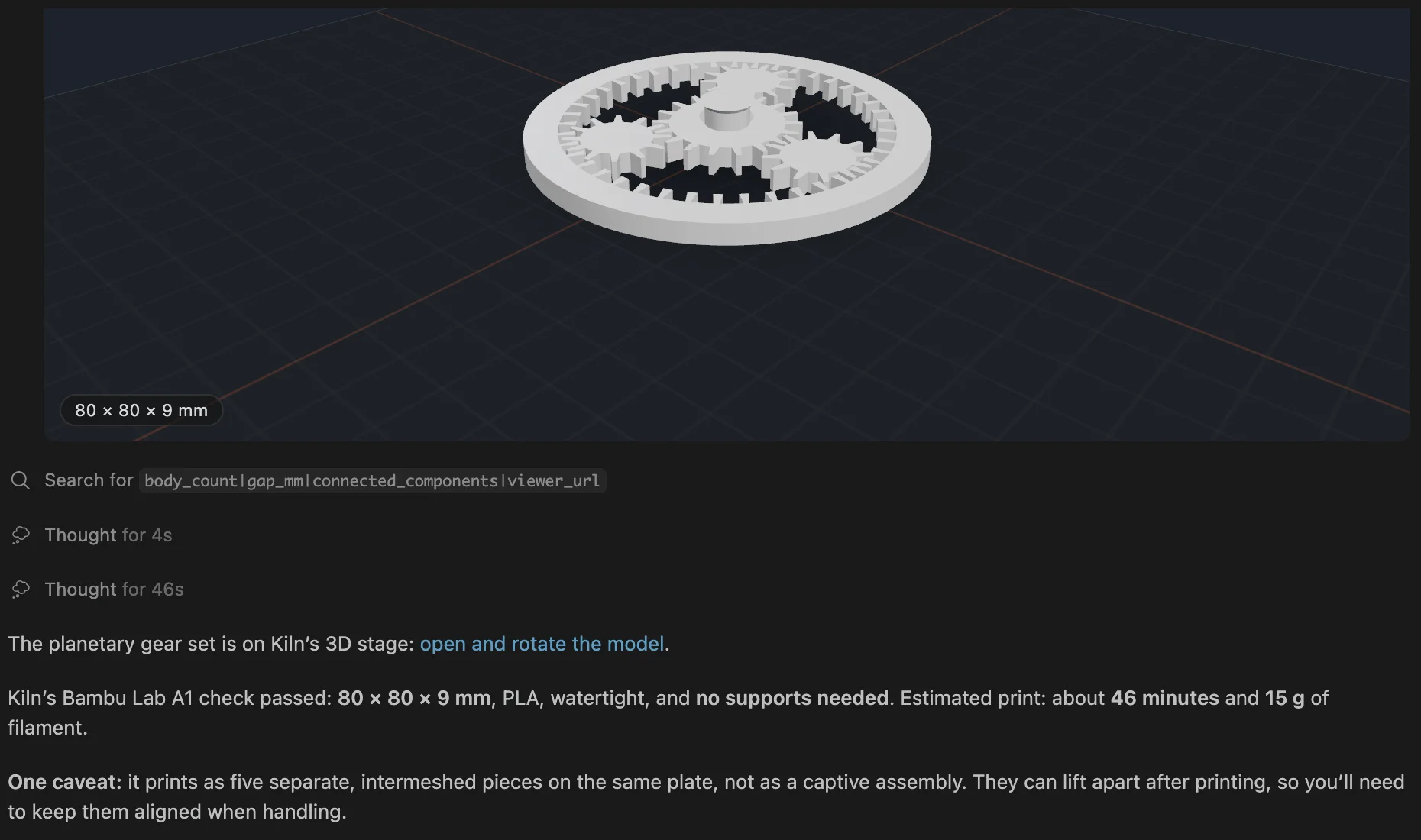
No link to open: Kiln’s 3D view appears inside Copilot’s chat in VS Code, right under the step that made the part.
Kiln checked the gear set for a Bambu Lab A1: watertight, no supports, about 46 minutes and 15 g of PLA. With Kiln Pro, it also says exactly what to change when a part is risky.
VS Code reads GitHub Copilot’s own settings file, so adding Kiln there once is all it takes.
Tested with GitHub Copilot in VS Code on a Mac. Starting and watching a print needs Kiln installed on the computer next to your printer.
The test conversation, shortened
Design a planetary gear fidget toy for my desk: an outer ring gear, a center sun gear and three planet gears that all mesh, laid out flat so the whole set prints in place without supports, about 80 mm across, with a knob on the sun gear to spin it. Check it will print on my Bambu Lab A1 and show it to me on Kiln’s 3D stage.
Kiln’s 3D view opens in the chat with the gear set
Kiln’s Bambu Lab A1 check passed: 80 × 80 × 9 mm, PLA, watertight, and no supports needed. About 46 minutes and 15 g of filament. It prints as five separate pieces on one plate.
What Kiln adds
The same job both ways, from a sentence to an object in your hands.
| Step | GitHub Copilot on its own | GitHub Copilot with Kiln |
|---|---|---|
| Make it | Writes CAD code. Seeing the shape takes a CAD program on your computer. | Kiln builds the model and opens it in 3D right in the chat. |
| Check it | A problem shows up in the slicer, or partway through the print. | Kiln checks overhangs, thin walls, warping risk, and whether it fits your printer, before anything prints. |
| Change it | Ask again and get new code. Keeping track of which version was better is on you. | Ask for a change in the same chat, and Kiln keeps every try tied to what you first asked for. Save it to your free Kiln account and you get version control: every version kept, and a branch for the risky idea. Pro does it on every design and draws what changed on the part. |
| Slice it | Export the file, open your slicer, and pick the settings. | Kiln slices it in the slicer you already have: PrusaSlicer, OrcaSlicer, or Bambu Studio. |
| Print it | Send the file to your printer yourself. | GitHub Copilot sends it to your printer, and it starts only after you say yes. |
| Watch it | Check on it in the printer’s own app. | Kiln watches every print it starts and stops it if a heater fails. Watch it live on kiln3d.com/monitor, with the camera, progress, and pause and stop, or ask GitHub Copilot how it’s going. |
| More printers | You run each one yourself. | Business runs several at once and picks the printer for each job. Free and Pro drive one at a time. |
The camera shows when your printer has one. A print can still fail, with Kiln or without it; Kiln catches what it can see before the print starts, and asks before it uses your plastic.
A few minutes on the computer next to your printer, with VS Code and GitHub Copilot installed.
Follow the install guide, or paste its setup message into an agent that can run commands, and it installs Kiln for you.
Open ~/.copilot/mcp-config.json (make it if it isn’t there) and add these lines. In a terminal, which kiln prints the path to put after "command". Then restart VS Code; it reads Copilot’s settings file on its own.
{
  "mcpServers": {
    "kiln": {
      "type": "local",
      "command": "/full/path/to/kiln",
      "args": ["serve"],
      "tools": ["*"]
    }
  }
}Open Copilot’s chat in VS Code, keep it in agent mode, and describe a part. Copilot asks before each Kiln step unless you allow them all. Ask it to find your printer on your network, or tell it the brand and model. See the printers Kiln works with.
Kiln’s 3D view opens right inside the chat, so you see the part before anything prints.
A print uses real plastic on a real machine, so Copilot can’t start one alone. Kiln shows you the part first, then waits for your yes. Auto-print is off unless you turn it on.
Yes, with Kiln. Describe a part in GitHub Copilot; Kiln designs it, checks it will print, and opens it as a 3D model right in the conversation. Kiln runs on the computer next to your printer, so GitHub Copilot can send the print there, and you approve it. Tested in GitHub Copilot in VS Code on a Mac.
Yes. With Kiln connected, GitHub Copilot turns a plain description into a real 3D model you can turn over, measure and change in the same chat, then print or download. No CAD skills needed.
GitHub Copilot can write the code for a 3D model. Kiln builds it, opens it in 3D right in the chat, checks it will print (overhangs, thin walls, warping, and whether it fits your printer), slices it in your own slicer, and sends it to your printer after you say yes.
The most capable one in Copilot’s model menu. Copilot offers models from several companies, Claude Fable 5.2 and GPT-6 Astra among them, depending on your plan. Our test ran on Copilot’s own automatic pick. Kiln does the checking and the printing; the model does the thinking, so a stronger model means better designs and fewer retries.
Install Kiln on the computer next to your printer, then add Kiln to GitHub Copilot’s settings file, ~/.copilot/mcp-config.json, and restart VS Code. The setup steps on this page take a few minutes.
Yes. Kiln’s 3D view opens right in Copilot’s chat in VS Code, where you can turn the part over and check its size.
Yes. Kiln’s live print monitor opens right in Copilot’s chat in VS Code and keeps itself up to date. We tested it with the printer switched off, where it showed the printer as offline.
GitHub lists MCP servers in agent mode as part of Copilot Free, so Kiln should work there. How much you can chat depends on your Copilot plan.
GitHub Copilot’s command line reads the same settings file, so the same lines add Kiln there too. We tested Copilot in VS Code.
No. Copilot can design a part and Kiln checks it will print on the printer you name. Our gear set was checked for a Bambu Lab A1 that was switched off. You need a printer, or someone else’s, to make it.
No. Kiln waits for your yes before every print. Auto-print is off unless you turn it on.
Bambu Lab, Creality, Prusa, Elegoo, and most Klipper and OctoPrint machines. The full list is on the supported printers page.
No. Kiln is independent, open-source software you can use from GitHub Copilot. It is not affiliated with or endorsed by GitHub or Microsoft.
Kiln is independent, open-source software. It is not affiliated with or endorsed by GitHub or Microsoft.