Pictures in the chat
Kimi showed Kiln’s preview pictures of the feeder right in the conversation, then handed back the link to turn it over in 3D.
Kiln in Kimi Code
Kiln gives Kimi what it needs to design a part, check it will print, and run it on your own printer. Add it once to Kimi Code, and you approve every step.
Kimi designed a hanging bird feeder with Kiln, Kiln checked it would print, and the feeder opened on Kiln’s 3D stage.
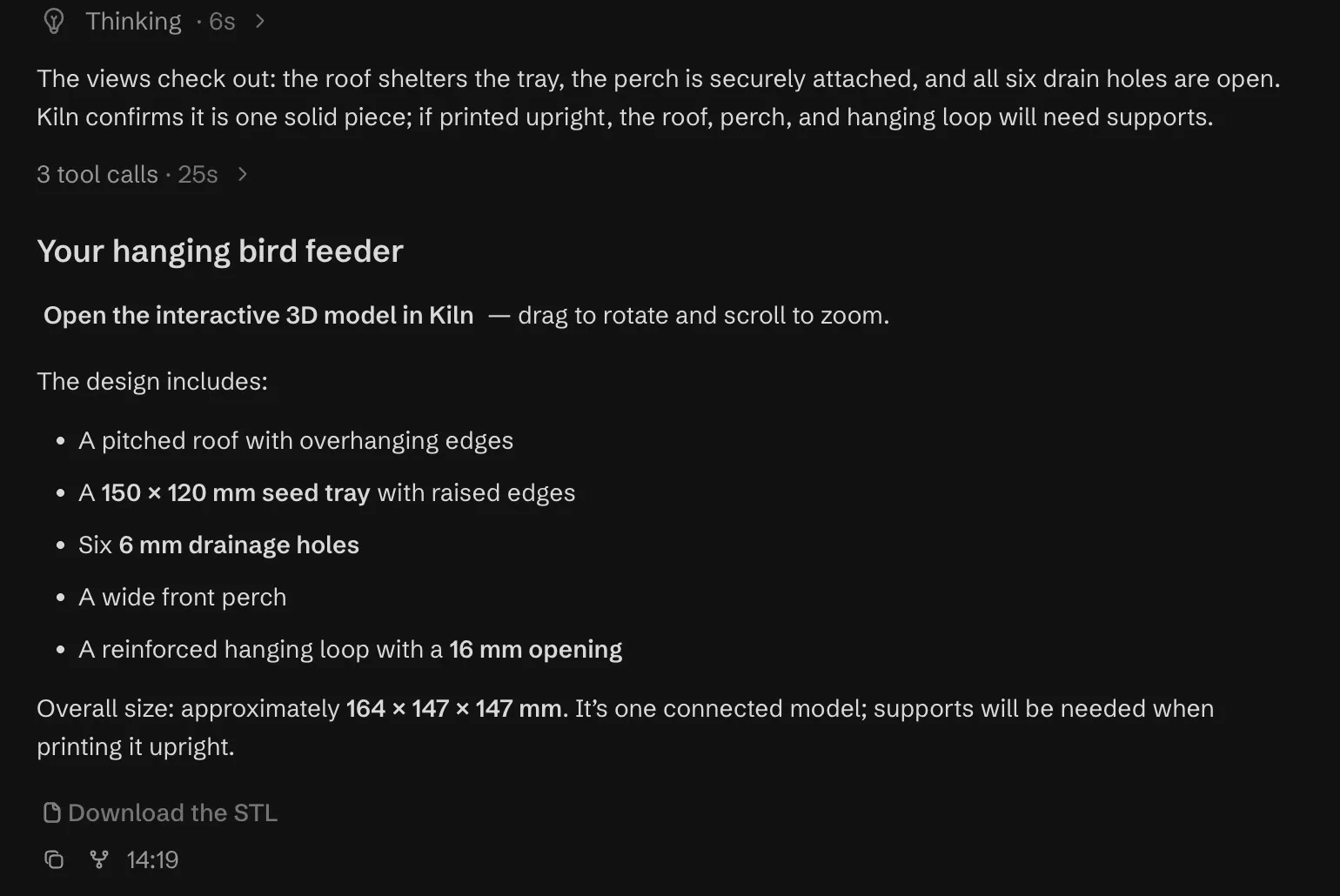
Kimi showed Kiln’s preview pictures of the feeder right in the conversation, then handed back the link to turn it over in 3D.
Kiln confirmed the feeder is one solid piece and flagged that the roof needs supports printed upright, and Kimi passed that on. With Kiln Pro, it also says exactly what to change when a part is risky.
Kimi asks before each Kiln step runs. Approve it once, or for the whole session.
Tested in the Kimi Code app on a Mac with Kimi K3.1 Pro. The 3D link lasts about half an hour. Starting and watching a print needs Kimi Code on the computer next to your printer.
The test conversation, shortened
Use Kiln to design a bird feeder I can hang in my garden: a little roof, a perch, and a tray that holds seed. Show it to me in 3D.
Kimi designs it with Kiln and checks it
Your hanging bird feeder: a pitched roof, a 150 × 120 mm seed tray with six drainage holes, a wide front perch and a hanging loop, about 164 × 147 × 147 mm. Kiln confirms it’s one solid piece; the roof needs supports printed upright.
The feeder opens on Kiln’s 3D stage
What Kiln adds
The same job both ways, from a sentence to an object in your hands.
| Step | Kimi Code on its own | Kimi Code with Kiln |
|---|---|---|
| Make it | Writes CAD code. Seeing the shape takes a CAD program on your computer. | Kiln builds the model and hands you a link that opens it in 3D. |
| Check it | A problem shows up in the slicer, or partway through the print. | Kiln checks overhangs, thin walls, warping risk, and whether it fits your printer, before anything prints. |
| Change it | Ask again and get new code. Keeping track of which version was better is on you. | Ask for a change in the same chat, and Kiln keeps every try tied to what you first asked for. Save it to your free Kiln account and you get version control: every version kept, and a branch for the risky idea. Pro does it on every design and draws what changed on the part. |
| Slice it | Export the file, open your slicer, and pick the settings. | Kiln slices it in the slicer you already have: PrusaSlicer, OrcaSlicer, or Bambu Studio. |
| Print it | Send the file to your printer yourself. | Kimi Code sends it to your printer, and it starts only after you say yes. |
| Watch it | Check on it in the printer’s own app. | Kiln watches every print it starts and stops it if a heater fails. Watch it live on kiln3d.com/monitor, with the camera, progress, and pause and stop, or ask Kimi Code how it’s going. |
| More printers | You run each one yourself. | Business runs several at once and picks the printer for each job. Free and Pro drive one at a time. |
The camera shows when your printer has one. A print can still fail, with Kiln or without it; Kiln catches what it can see before the print starts, and asks before it uses your plastic.
A few minutes, on the computer next to your printer.
Download the Kimi Code app from kimi.com/code and sign in. Kimi starts Kiln with uv; if you don’t have it yet, the install guide shows the one line that adds it.
Open ~/.kimi-code/mcp.json (make it if it isn’t there), add these lines, then quit and reopen Kimi Code. Kimi loads Kiln’s tools only when it needs them, and the longer start time gives Kiln room to download the first time.
{
  "mcpServers": {
    "kiln": {
      "command": "uvx",
      "args": ["kiln3d", "serve"],
      "deferred": true,
      "startupTimeoutMs": 180000
    }
  }
}Start a chat in a project and describe a part. Kimi asks before each Kiln step; approve it once or for the whole session. Ask it to find your printer on your network, or tell it the brand and model. See the printers Kiln works with.
Kimi shows Kiln’s preview pictures in the chat and hands back Kiln’s link. Open it in your browser to turn the part over before anything prints.
A print uses real plastic on a real machine, so Kimi can’t start one alone. Kiln shows you the part first, then waits for your yes. Auto-print is off unless you turn it on.
Yes, with Kiln. Describe a part in Kimi Code; Kiln designs it, checks it will print, and hands back a link that opens it in 3D in your browser. Kiln runs on the computer next to your printer, so Kimi Code can send the print there, and you approve it. Tested in the Kimi Code app on a Mac.
Yes. With Kiln connected, Kimi Code turns a plain description into a real 3D model you can turn over, measure and change in the same chat, then print or download. No CAD skills needed.
Kimi Code can write the code for a 3D model. Kiln builds it, hands you a link that opens it in 3D, checks it will print (overhangs, thin walls, warping, and whether it fits your printer), slices it in your own slicer, and sends it to your printer after you say yes.
Kimi K3.1 Pro, the newest model in Kimi Code. Our test ran on it. Kiln does the checking and the printing; the model does the thinking, so a stronger model means better designs and fewer retries.
Install Kiln on the computer next to your printer, then add Kiln to Kimi Code’s settings file, ~/.kimi-code/mcp.json, and restart Kimi Code. The setup steps on this page take a few minutes.
No separate step. Kimi Code starts Kiln with uv the first time you chat. If uv isn’t on your computer yet, the install guide shows the one line that adds it.
Yes. Add Kiln’s online connector to the same settings file instead: an entry named kiln-hosted with "url": "https://api.kiln3d.com/mcp-full" and "deferred": true. Then sign in once from Kimi’s terminal: start kimi, type /mcp-config login kiln-hosted, and approve; Kiln’s sign-in page opens in your browser. Kimi then designs and checks parts on Kiln’s servers and hands back the 3D link. With Kiln on the computer next to your printer, Kimi can start prints on it and check on them, and you approve every one.
Kimi shows Kiln’s preview pictures in the chat and hands back a link to Kiln’s 3D view. Open it in your browser to turn the part over. The link lasts about half an hour.
No. Kimi can design a part and Kiln checks it will print. Our bird feeder was designed with the printer offline. You need a printer, or someone else’s, to make it.
Kiln shows you the model, then waits for your yes before every print. You can say yes for a while, up to a day, so it stops asking on that printer, and end that whenever you like; a print already running carries on either way. Auto-print is off unless you turn it on.
Bambu Lab, Creality, Prusa, Elegoo, and most Klipper and OctoPrint machines. The full list is on the supported printers page.
No. Kiln is independent, open-source software you can use from Kimi Code. It is not affiliated with or endorsed by Moonshot AI.
Kiln is independent, open-source software. It is not affiliated with or endorsed by Moonshot AI.